

Inside South Africa’s bold new space STEM initiative
Big news is brewing in the world of space science. In a groundbreaking first for South Africa, Rooibos seeds are officially bound for the International Space Station. This stellar initiative, known as the Rooibos in Space programme, officially launched today at Parklands College’s Innovation Centre in Cape Town. The event successfully brought together representatives from government, academia, education, agriculture, and the rapidly growing space economy.
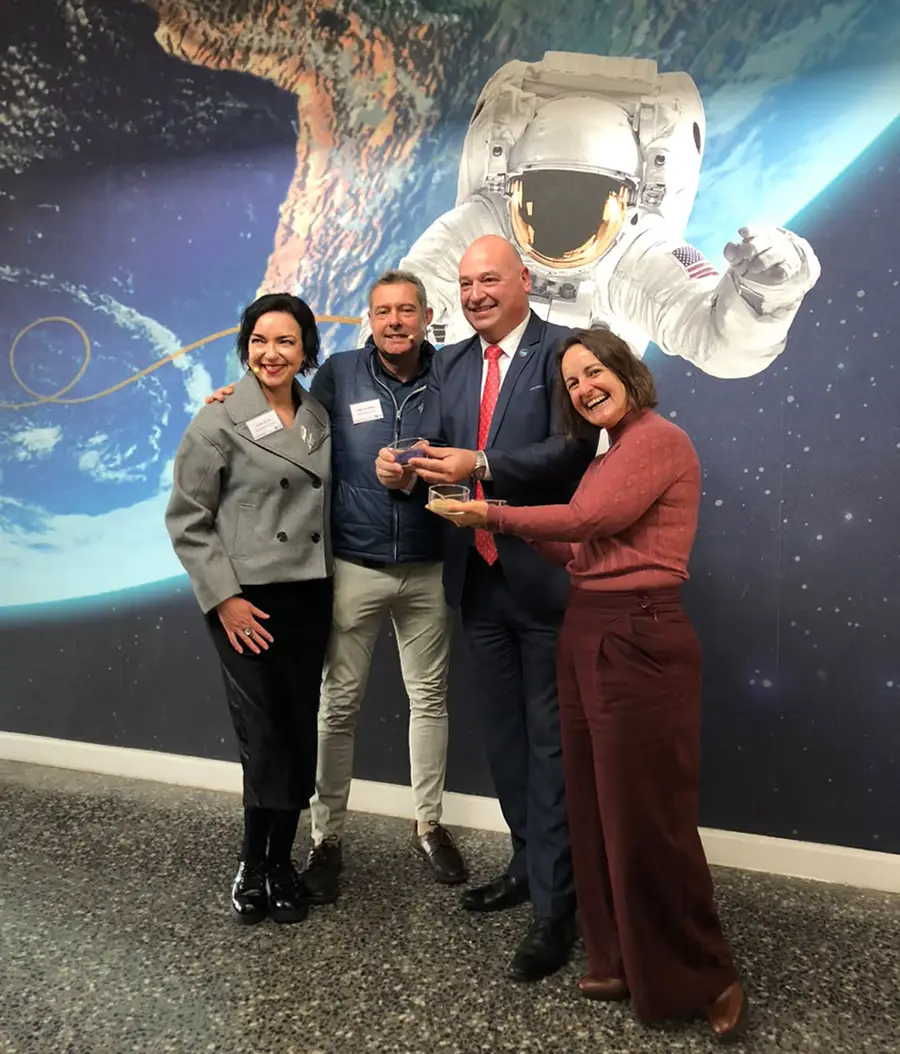
From left: Adel Du Toit, Dawie de Villiers, Aldermen James Vos (MCM for Economic Growth), Marthane Swart
Conceptualised by the South African Rooibos Council, SARC, and delivered alongside MaxIQ Space, with key support from the South African National Space Agency, SANSA, this project is connecting our beloved indigenous plant to the global frontier of space biology. Using Rooibos, a truly unique South African plant, the project engages learners in cutting edge space science while exploring the potential role of plants in future space exploration and off Earth living systems.
How the Mission Works
In October, these high-flying Rooibos seeds will blast off to the ISS. They will spend several weeks exposed to microgravity and space radiation before returning home to Earth. Once they land, the real scientific fun begins.
- The Local Experiment: Learners from seven schools in the historic Cederberg region, the birthplace of Rooibos, will team up with local Rooibos farms.
- The Scientific Study: They will plant the space seeds alongside control seeds to study and compare germination, growth, resilience, and overall yield.
- Comparative Data: A parallel experiment hosted at Parklands College will provide additional data for the study.
This project aligns with a global movement, heavily driven by upcoming long duration exploration missions like NASA’s Artemis, to develop self-sustaining life support systems capable of cultivating crops for food, oxygen, and crew wellbeing. While previous ISS missions have tested lettuce, peas, and soybeans, our local Rooibos is now joining this elite scientific lineup to help advance future space based agricultural systems.
Empowering the Next Generation
Dawie de Villiers, Director of SARC, noted that this project perfectly places South Africa’s agricultural heritage within a broader scientific context where plant biology, space research, and education intersect. He highlighted that it reflects the vital importance of investing in scientific literacy and skills development for the next generation of researchers.
Beyond the scientific component, participating schools will dive into an extended STEM education programme designed to connect classroom learning with practical scientific applications. Judi Sandrock of MaxIQ Space added that the true value of the initiative lies in giving learners direct exposure to authentic research processes, data analysis, and practical experimentation.
To make this a truly national celebration, learners across South Africa are also invited to design the official Rooibos in Space mission patch during July and August, extending the excitement far beyond the participating classrooms.
A Unified Scientific Frontier
The initiative highlights South Africa’s expanding role in space science and cross sector partnerships. Bertram Loriston from the Western Cape Education Department praised the project for making science accessible to learners by connecting education with agriculture.
SANSA’s Thandile Vuntu emphasized that space science is increasingly integrated into daily life, from communications to environmental monitoring. This project helps build the skills required for future participation in the sector while strengthening South Africa’s position in emerging scientific fields.
Adding an inspiring personal perspective, Dr Kelebogile Gasealahwe, a South African Radio Astronomy Observatory, SARAO, postdoctoral fellow at the University of Cape Town, UCT, whose research focuses on astronomical X ray binaries, shared her journey from humble beginnings in Kimberley to cutting edge astrophysics. She highlighted the critical role of world class facilities, like the MeerKAT radio telescope, and encouraged learners to remain open to diverse pathways in STEM.
Follow the Journey!
The excitement does not stop with the launch. Public engagement will continue to grow as the project counts down to its October ISS flight. You can follow every milestone, update, and activity of the Rooibos in Space journey directly.
All official updates will be shared on the South African Rooibos Council website at www.sarooibos.co.za. You can also follow the journey on social media via @RooibosCouncil on Facebook and @SARooibosCouncil on Instagram.